Credits are 100 to the dollar
Start there and the rest is arithmetic.
Credits are how Perplexity counts the work Computer does
Max gives you 10,000 a month, which is $100 of work, plus a one time 35,000 bonus when you start. Every job you run uses some. A quick question is a few. A full website build is a few thousand. You can always see what a job cost in the right panel of its session, and what the month cost under Settings, Usage and credits.
There are three kinds of cost, and keeping them apart is what stops the surprise. Setup is what it costs once to put everything in: install the agents, run Foundation, build your map, give each agent its first read. It is bigger than a month of running and you pay it once. Builds are the big one off jobs: a funnel, a sales page, a book chapter. Running is what your scheduled jobs and your everyday agent work cost each month, and that is the number that matters after month one.
Two things drive every number on this page
Which model is doing the work, which we covered in module 13, heavy models cost about five times what light ones do. And how long the session is, because every message re reads everything above it. I had one daily job sitting inside a two week old thread and it was costing about seventy dollars a day. Moved to a fresh thread, a few dollars. That one habit is worth more than every other thing on this page.
Where the numbers come from
Some are measured on my own accounts and I say so in the note. The rest are ranges worked out from how the agents run and what the models charge. Your numbers will be different, and by the end of week one you will have your own, because the steps below tell you where to look.
What you do, step by step
Open Settings, then Usage and credits.
This is the bill. Two numbers: credits used this cycle, and the renewal date. Look at it every week for the first month.
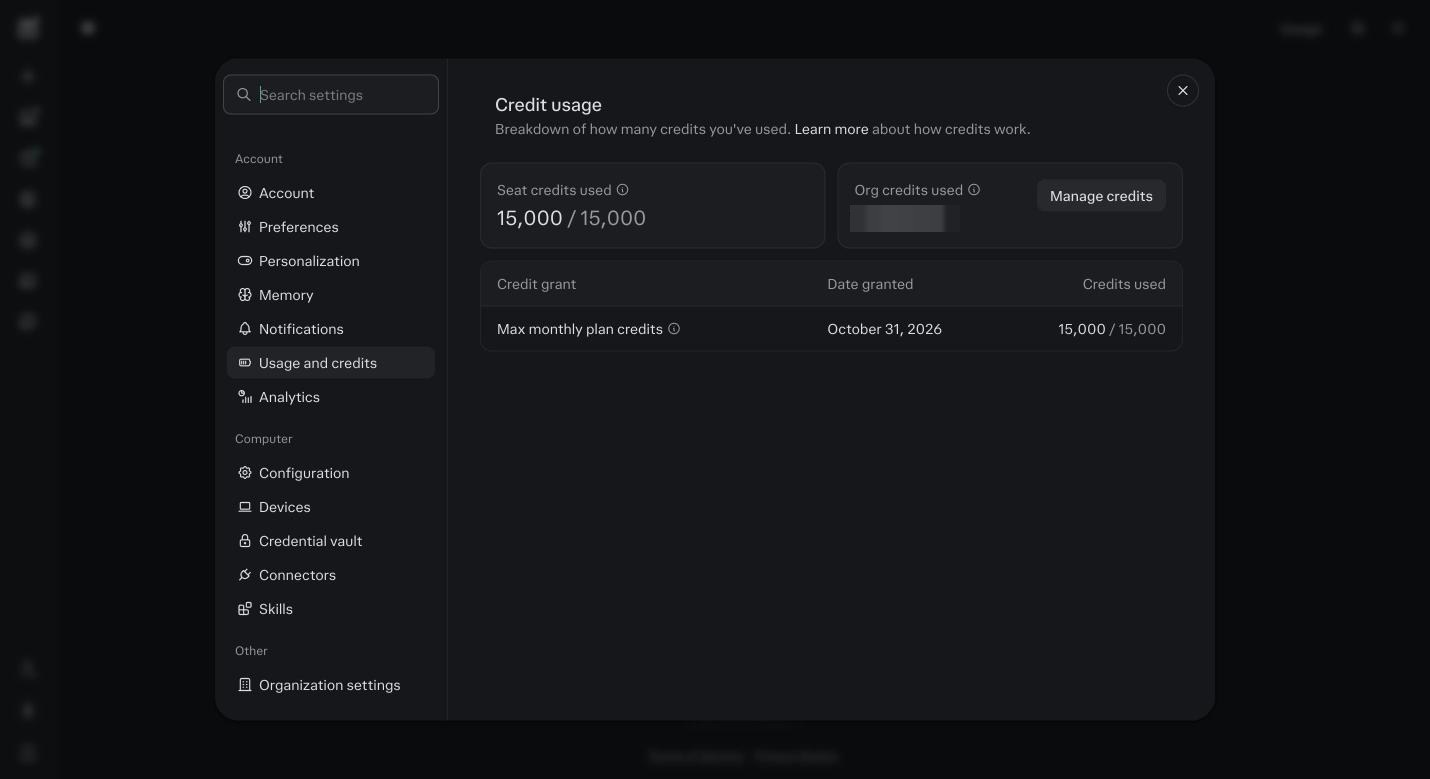
Usage and credits. Credits used against your grant and the date it renews. Open Settings, then Analytics.
It shows credits by day and by model, artifacts created, and which skills ran. The model split is the most useful thing on the page. If most of your credits sit under a heavy model, your automations are set too high.
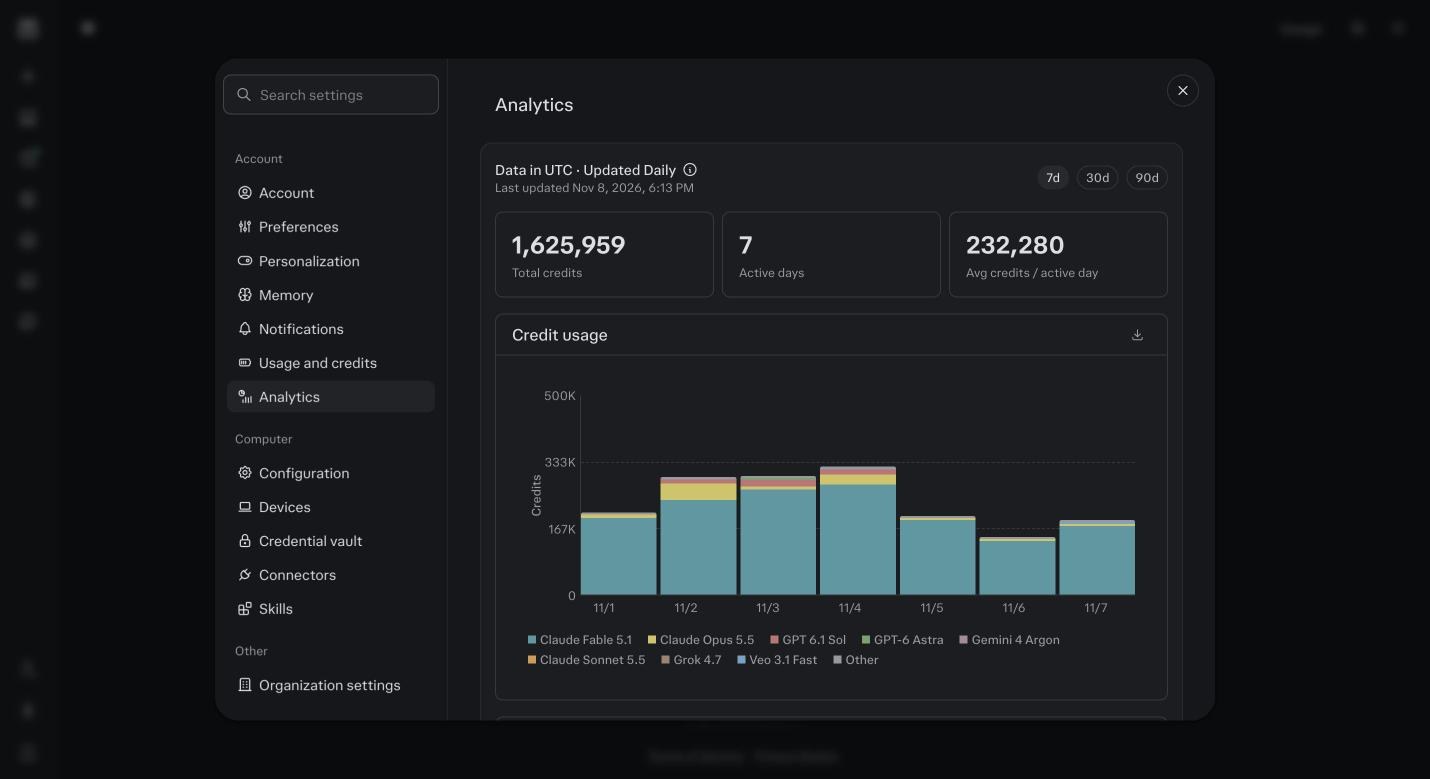
Analytics on my own account, last seven days. Almost everything under Claude Fable because I build products all week. Yours should look lighter. Learn to read Session usage.
Open any session. The right panel shows the credits that session has used. After every real job in week one, glance at it and write the number next to the job on your map. By Friday you have your own version of the table below.
Read the job table below.
Find the five jobs you will actually run most. Add them up for a week, times four. That is your running cost estimate.
Pick your scenario in the month table and write down the number.
That is your first month budget. Put it where you will see it on day 30.
Three spend well rules.
New session per job, every time. Schedules at the cadence the output needs, a weekly review does not need to be daily. Credit ceilings wherever an agent offers one, the Funnel Agent asks before it builds and defaults to 3,500.
Turn on auto refill in Usage and credits so an agent never stops mid job, and set the refill amount to something you would not mind seeing on a card statement.
$20 is fine to start.
What A Dollar Buys
$1, 100 credits
Five to ten quick questions in a plain session. Or one short daily briefing. Or an inbox sort on a light morning.
$10, 1,000 credits
Two or three emails written in your voice. Or one weekly review of everything the agents did. Or an ads review of the last 30 days. Or a five email sequence at the low end.
$100, 10,000 credits
Your whole monthly grant on Max. Enough for two daily automations, a weekly review, a weekly email and a dozen agent jobs, if the sessions are short. Or one full website build.
$350, 35,000 credits
The one time bonus when you start Max. It expires about 30 days after you get it. It covers your setup: the core install, Foundation Light, the mapping session and the first reads, with room left, if you do them in month one.
What things cost
| Job | Credits | Best model and effort | In dollars | Note |
|---|---|---|---|---|
| Everyday jobs, what they cost each time | ||||
| Quick question in a plain session | 5 to 20 | Light. Sonnet 5.5 or GLM 5.3 | $0.05 to $0.20 | No tools, no files. Close to free. |
| Daily briefing: calendar, inbox, yesterday’s numbers, in a short thread | 100 to 300 a run | Standard. Kimi K3 or Sonnet 5.5 | $1 to $3 a run | Twenty weekday runs is 2,000 to 6,000 a month, $20 to $60. Keep the thread short or this number triples. |
| Inbox triage with drafted replies | 200 to 500 a run | Standard. Kimi K3 | $2 to $5 a run | A longer inbox is a longer run. Drafts only, you send. |
| Weekly review of what the agents produced | 300 to 800 a run | High. Opus 5.5 | $3 to $8 a run | Four a month. Reads every session in the Project. |
| One email in your voice, drafted and loaded on approval | 150 to 400 | High. Fable 5.2 | $1.50 to $4 | Your voice needs the heavy tier. Loading through the connector adds almost nothing. |
| Five email sequence | 600 to 1,500 | High or Ultra. Fable 5.2 | $6 to $15 | One session, one sitting. Ultra if the offer is new. |
| Content from three calls into five posts | 500 to 1,200 | High. Opus 5.5 | $5 to $12 | Reading the transcripts is most of the cost. Shorter calls, cheaper posts. |
| Ads review, last 30 days of a Meta account | 400 to 1,000 | High. Opus 5.5 or Fable 5.2 | $4 to $10 | Any agent’s first real run on your own data lands about here. |
| Six ad variations scored, plus three static images | 800 to 2,000 | High. Fable 5.2 for the copy | $8 to $20 | Images cost more than words. Half of this is the three statics. |
| Sales page or site build with the Website Agent | 1,500 to 7,100 | Ultra. Fable 5.2 or GPT-6 Astra | $15 to $71 | A full buyer site build ran 7,101 on my account. Set a ceiling before you start. |
| Funnel build, pages plus emails plus ad angle | 1,800 to 3,500 | High or Ultra. Fable 5.2 | $18 to $35 | The agent warns you at half the ceiling. 3,500 is the default ceiling and you can change it. |
| Deep Research or Model Council on one decision | 500 to 2,000 | Ultra. Uses several models by design | $5 to $20 | Heavy on purpose. For decisions that cost more than $20 to get wrong. |
| Podcast or call into show notes, a summary and three quotes | 150 to 400 | Standard. Sonnet 5.5 or Gemini 4 Carbon | $1.50 to $4 | One hour of audio is the usual size. Transcripts cost more to read than to write about. |
| A client proposal from a call and your offer spec | 300 to 800 | High. Opus 5.5 or Fable 5.2 | $3 to $8 | Reads the call, Foundation and the spec. The draft is the expensive part, the edits are cheap. |
| Onboarding a new client: welcome email, intake, first week plan | 400 to 1,000 | High. Fable 5.2 for the client facing words | $4 to $10 | The Delivery Agent does this once per client. Agencies, multiply by clients. |
| Follow up drafts for ten quiet leads | 200 to 500 | High. Fable 5.2 | $2 to $5 | Reads calendar, CRM and inbox first. Your voice matters here, so not Light. |
| A month of social posts, thirty, from your transcripts | 1,500 to 3,000 | High. Opus 5.5 | $15 to $30 | Cheaper per post than five at a time, because the transcripts are read once. Review in two sittings. |
| One book chapter, 4,000 words, from your outline and stories | 800 to 2,000 | Ultra. Fable 5.2 | $8 to $20 | Long form in your voice is the heaviest writing there is. Worth it, and not a job for Light. |
| A designed PDF guide, twelve pages, from existing copy | 1,000 to 2,500 | High. The design pass, not the words | $10 to $25 | Rendering and checking pages is what costs. Fix the words before the design pass. |
| Collecting and sorting fifty testimonials with permission drafts | 500 to 1,200 | Standard for the sort, High for the asks | $5 to $12 | The Proof Agent reads Drive, inbox and calls once. After that, pulls are nearly free. |
| A Comet task: build an automation inside a tool with no API | 500 to 1,500 | Standard. Reading screens is the cost | $5 to $15 | Clicking through a builder step by step. Dearer than a connector, cheaper than you doing it. |
| A research report on a market or a competitor, Deep Research | 800 to 2,500 | Ultra by design | $8 to $25 | Reads dozens of sources. Once a quarter, not once a week. |
| A 90 day cash forecast from your books | 300 to 700 | High. Opus 5.5 | $3 to $7 | Reads QuickBooks or Stripe through the connector. Run it monthly. |
| A webinar outline and slides copy from your framework | 600 to 1,500 | High or Ultra. Fable 5.2 | $6 to $15 | Your method in your words. Ultra if the webinar sells something new. |
| Image Agent: ten quote cards in your brand | 400 to 1,000 | Standard for text, image generation is the cost | $4 to $10 | Images cost more than words. Batch them. |
| Strategy Agent monthly pillar score | 500 to 1,200 | High. Opus 5.5 | $5 to $12 | Reads every agent’s saved work in the Project. Once a month. |
| Setup jobs, paid once | ||||
| The mapping session in module 8, reading your tools and your profile | 300 to 800 | High. Opus 5.5 | $3 to $8 | Reading two weeks of email and calendar is most of it. The paper sketch in module 3 costs nothing. |
| Foundation Light | 250 to 1,350 | Standard, not High | $2.50 to $13 | The effort setting is everything here. Two runs on Standard came in at 232 and 283. The demo run in this course, on Fable 5.2 at High, came in at 1,313 for the same 38 questions. Move the slider to Standard before you start. Budget 300 on Standard. |
| Foundation Regular | 1,500 to 4,000 | High. Opus 5.5 | $15 to $40 | Sits between Light and Full. Four to five hours of your time is the real cost. |
| Foundation Full | 5,200 to 8,900 | Ultra if you can. Fable 5.2 | $52 to $89 | 5,190 on Standard, 8,872 on Ultra. Same interview, different model. The Ultra profile is the better one. |
| Full bundle install, every agent saved as a Project skill | 500 to 1,500 | Standard. The installer does not need a heavy model | $5 to $15 | Staged by hand in the demo Project at 515 for all twenty one. The installer itself is not measured yet, so budget the top of the range. Foundation and the first reads are the real setup cost, not this line. |
| Install one add on agent and run it once | 300 to 800 | Standard for the install, High for the first run | $3 to $8 | Sales install plus five turns 294. QA buyer run 388. QA install plus three checks 718. |
| Every agent’s first real read of your data | 300 to 800 each | High. Opus 5.5 | $3 to $8 each | Six core agents is 1,800 to 4,800. This is where the install becomes useful. |
| Every agent installed and each run once | 10,000 to 12,000 | High | $100 to $120 | I did this on a made up business with nineteen agents and it came to about 11,500. Delivery, Funnel and Offer led. Why the core six go first. |
| The mistake that costs the most | ||||
| A daily job left in a two week old thread | 5,000 to 7,000 a day | Any model. The thread is the cost, not the model | $50 to $70 a day | Measured on my own account, 22 runs over 12 days. Move the job to a fresh thread and it drops to the briefing line above. |
100 credits is one dollar. Every number is a range from my own accounts and test runs, rounded. Run the job at the model shown and you will land inside the range. Run it heavier, or in a long thread, and you will not.
What setup costs, by the size of your business
Setup is paid once, and it is more than one month of running. The bigger the business, the more tools to connect, the more data for each first read, and the more hours up front. These are the honest ranges.
| Your business | Upfront credits | Upfront time, self guided | What drives it |
|---|---|---|---|
| Solo coach or consultant, one business, core six agents | 3,000 to 8,500 | 8 to 10 hours across a week | The bundle install, Foundation Light, the mapping session, six first reads. Two or three connectors. |
| List or ads driven business, core six plus Ads and Sales | 5,000 to 13,000 | 12 to 16 hours across two weeks | Two more agents, Foundation Regular, more connectors with API keys, and more data for each first read to get through. |
| Agency with three client Projects | 9,000 to 25,000 | 16 to 22 hours across a month | The first client is the full course. Each client after it is another 4 to 6 hours: a Project, Foundation Light, core installs and first reads on their data. |
| Team of two or more operators | Add 2,000 to 5,000 per seat | Add 2 to 4 hours per person | Each person connects their own tools and runs their own first reads. Shared logins break the connector cards. |
Pick your row
Solo coach or consultant, core six, two automations, a dozen agent jobs a month
- Month one
- 13,000 to 20,000 in month one, $130 to $200
- Months after
- 12,000 to 20,000 a month after, $120 to $200
The 35,000 bonus expires about 30 days after you start, so it has to cover month one. With the 10,000 grant on top, a solo setup fits inside it. From month two, $20 to $100 of extra credits a month.
List or ads driven business, core six plus Ads and Sales, four automations, weekly campaigns
- Month one
- 21,000 to 31,000 in month one, $210 to $310
- Months after
- 25,000 to 40,000 a month, $250 to $400
The grant covers about a third. Budget $150 to $300 of extra credits a month. Still less than one part time hire.
Agency with three client Projects, core six per client, briefings per client
- Month one
- 45,000 to 65,000 in month one, $450 to $650
- Months after
- 60,000 to 100,000 a month, $600 to $1,000
Consider a seat per operator. Track by Project in Analytics and bill it through.
My own account, building and running products all week
- Month one
- Not a month one. About 1,625,000 in one week
- Months after
- Not a benchmark
Shown so you know what the top of the curve looks like and that it is not yours. Dozens of automations, long builds, heavy models on purpose.
Before you ask
Why not just say a number?
Because the honest number depends on your map. A coach running two light automations and a weekly email is under $200. An agency running briefings for five clients is over $600. Pick your row in the table.
What happens when I run out mid month?
With auto refill on, it buys more in the step you set and the job keeps going, until you hit your monthly spending cap. With it off, running jobs pause, your work is saved, and they pick up on their own once credits are back. Turn auto refill on and set the amount low. Running out halfway through Foundation is a bad afternoon.
Is Max worth it over Pro at these numbers?
Yes. Pro has no monthly credits and no Brain. The 10,000 credits alone are $100 of the $167, and Brain is what makes month two cheaper than month one.
Why is month one so much more?
Setup. Installing the agents, Foundation, the mapping session and every first read happen once. Your 35,000 bonus exists for exactly this, and it expires after about 30 days, so do not sit on it. From month two you are only paying for running and the odd build.
What is the single most expensive mistake?
A daily job left in a long thread. It cost me $50 to $70 a day. New session, same job, a few dollars. Second is an automation left on Ultra. Third is Deep Research used for things a plain question would answer.
How do I know what a job cost?
Open the session. The right panel shows its usage. Write the number next to the job on your map in week one. Settings, Analytics shows the month by model, which is how you catch an automation set too high.
Can I set a limit so an agent cannot overspend?
Agents that build ask for a ceiling and warn you at half. For everything else, auto refill with a small amount is your limit: it tops up in steps you chose, and you see each one. There is also a monthly spending cap on every Max account. It defaults to $200 and you can set it anywhere up to $5,000 in your credit settings. When you hit it, running jobs pause and nothing more is charged until you raise it.
Is Comet cheaper than a connector?
No. Comet reads screens and clicks step by step. A connector reads the data directly. Same job, the connector is usually a third of the price. Use Comet only where no connector exists.
Should I buy extra credits up front?
No. Turn on auto refill and let it top up as you go. Buying a big block up front just makes a wrong setting cost more before you notice it.
My credits went in a day. Is something broken?
Probably not. Setup week looks like that. Foundation, the context load and the first reads run heavy models on long jobs, and a $200 grant can go in a day while that is happening. What is not normal is week three looking the same. Check Usage, set the spending cap, and move routine jobs to a lighter model.